Research
Research at the intersection of world models and wireless networks
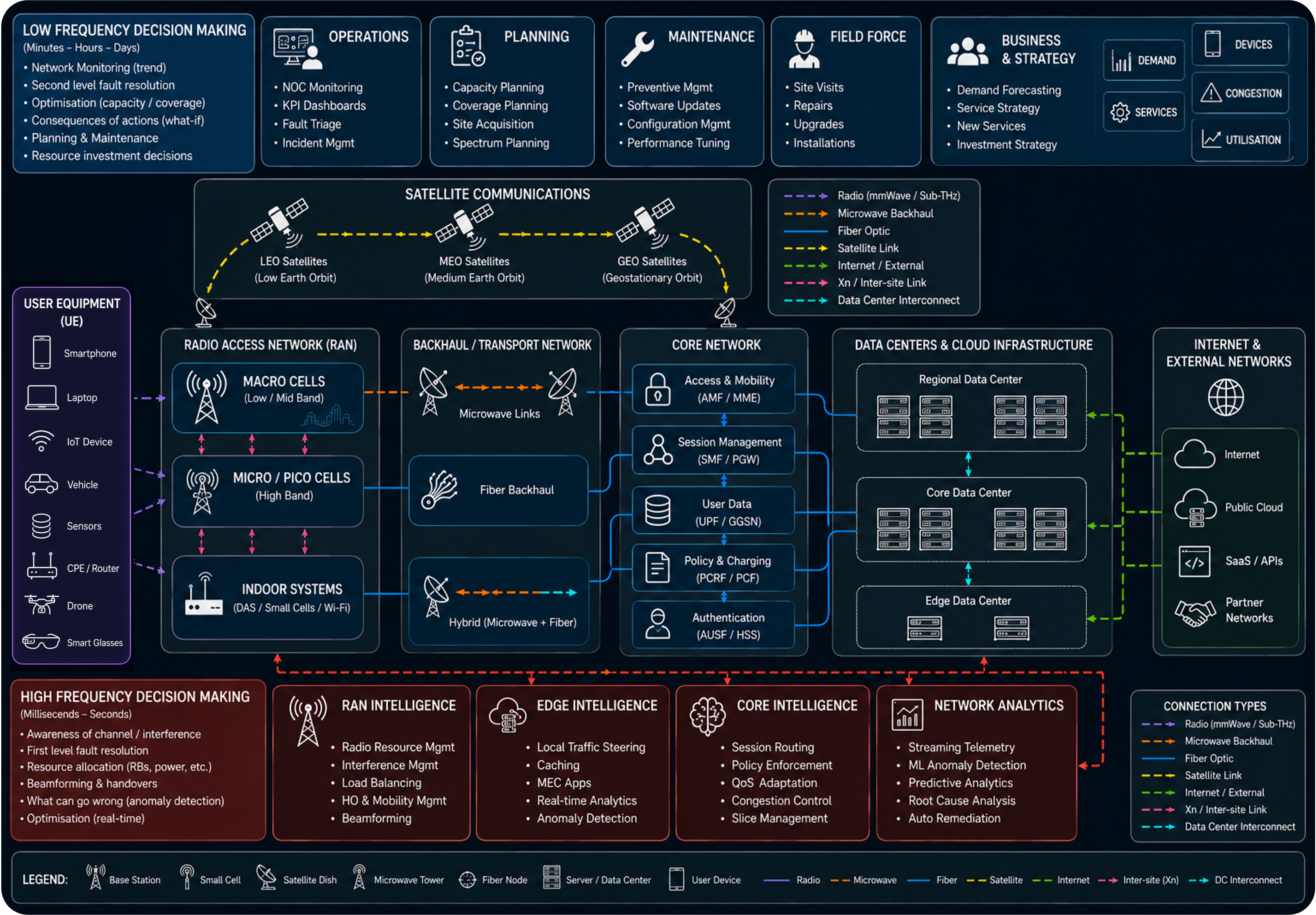
Large language models (LLMs) are powerful tools for text summarisation, coding, and language-based reasoning, but language is, as researchers describe it, “an incredibly lossy compression of reality.” Wireless networks are not fundamentally language problems. They are dynamic physical and cyber-physical systems shaped by interference, mobility, topology, traffic demand, energy constraints, faults, and control actions that unfold continuously over time, more like a video than a sentence.
An LLM predicts the next token in a discrete symbol sequence. A wireless network controller must instead estimate the latent network state, predict how that state will evolve, and reason about the consequences of its actions. For example, what happens if a scheduler changes, a base station enters sleep mode, a handover policy shifts, or site equipment begins to degrade? Beyond prediction, the system must plan sequences of future actions, evaluate alternative strategies before execution, and optimise for objectives such as network performance, energy efficiency, reliability, cost, and user experience. This form of action-conditioned forecasting and decision-making depends on grounded state representations, causal structure, temporal consistency, and explicit models of system dynamics, none of which are native strengths of text-trained models.
This is why the research direction here looks beyond LLMs alone toward world models, JEPA-style predictive representations, graph neural networks, model predictive control, reinforcement learning, optimisation methods, and digital twins. Together, these approaches enable AI systems to build internal models of network behaviour, simulate the consequences of alternative decisions, plan over long time horizons, and optimise control policies before acting in the real network. They are therefore better aligned with noisy, partially observable, safety- and energy-critical wireless environments where AI must do far more than produce plausible language. It must reliably predict, plan, optimise, and control complex network operations.
Research Areas
Wireless World Models and Foundation Models
Developing shared latent models for wireless networks and smart farms that support prediction, simulation, planning, and autonomous control.
Graph Intelligence for Networked Physical Systems
Using graph neural networks to model topology, interference, sensing, and resource dependencies across interconnected wireless systems.
Predictive Orchestration and Adaptive Forecasting
Connecting forecasting directly to operational decisions for proactive orchestration of radio, compute, energy, irrigation, and sensing resources.
Sustainable AI and Energy-Intelligent Infrastructure
Designing AI methods that reduce energy waste while improving resilience through anomaly detection, thermal optimisation, and efficient edge intelligence.
AI-Native Wireless Agriculture, SDR, and Open RAN
Building intelligent agricultural systems with wireless sensing, drone data, SDR, and Open RAN for affordable, sustainable, and AI-native rural connectivity.
Autonomous Robotics for Field and Site Operations
Developing autonomous systems for inspection, monitoring, navigation, and physical task automation in mobile sites and agricultural environments.